

Table of Contents
- Do you need FIRB approval to buy a home in Australia? The #1 rule
- Who counts as a “foreign person” for FIRB purposes?
- The partner exemption: buying with an eligible partner
- What about New Zealand partners and the 461 visa?
- Buying property solo, without an AU/NZ partner
- FIRB approval fees for residential property (2026–27)
- The FIRB application process, step by step
- What happens if your FIRB application isn’t approved?
- Who can apply for a home loan, by visa type
- How MAP Home Loans helps you get approved
- Frequently asked questions
If you’re on an Australian visa and looking to buy or invest in residential property, then you may have heard of “FIRB approval”. FIRB stands for Foreign Investment Review Board and FIRB approval is the process of obtaining permission to legally purchase a home (or other assets) in Australia as a foreign person.
This article unpacks everything visa holders need to know about the FIRB approval process, including:
- When FIRB approval is required and when it is not
- FIRB approval rules, fees and timeframes
- How to stay compliant and common mistakes to avoid
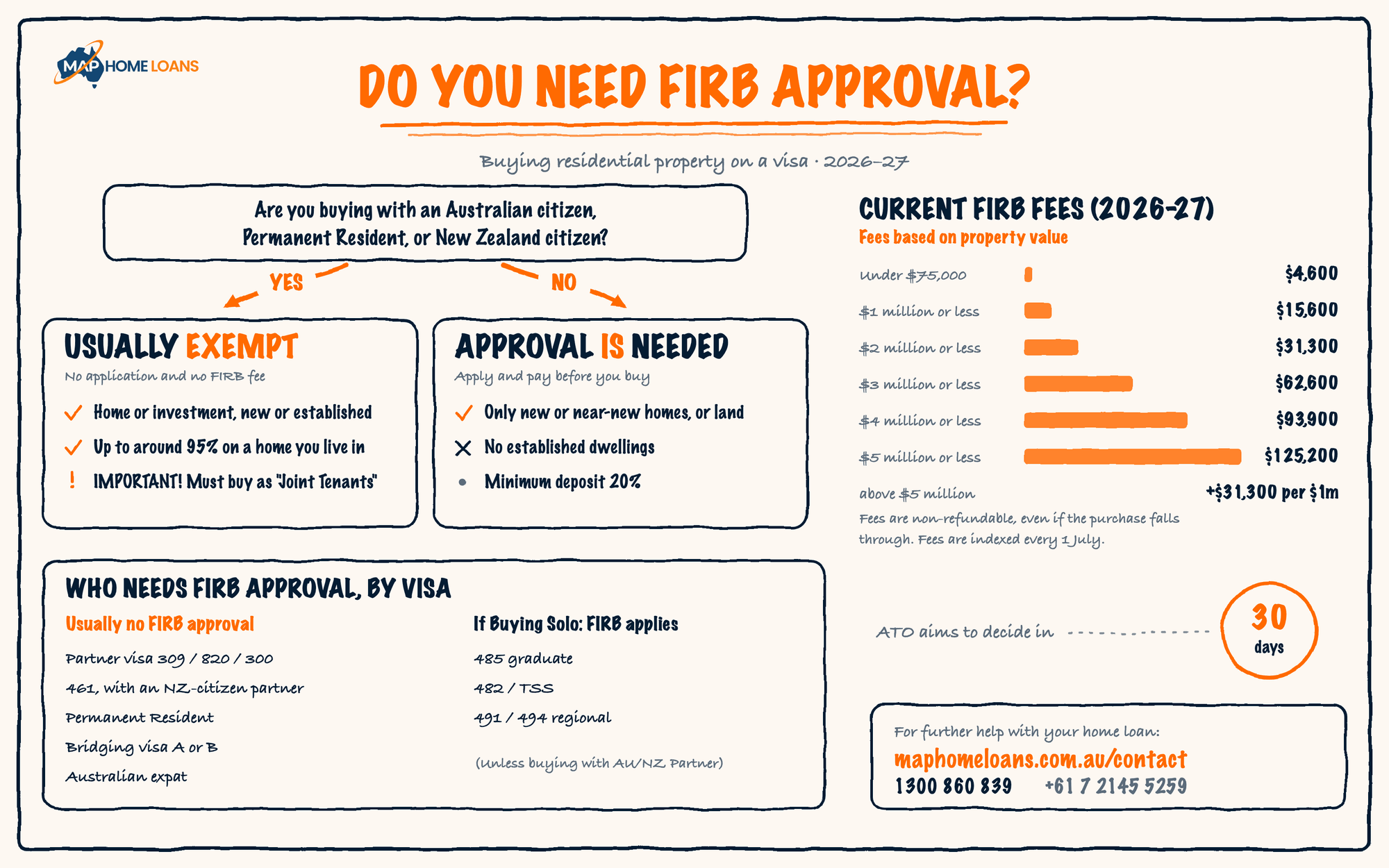
Do you need FIRB approval to buy a home in Australia? The #1 rule
Whether you need FIRB approval at all, and what you can buy, comes down mostly to who you are buying with.
If you are buying with an Australian citizen, an Australian permanent resident, or a New Zealand-citizen partner, you may be exempt from FIRB approval and its fees for a home or an investment, and that can include an established home. On an investment, some states can still charge the foreign buyer surcharge.
If you are on a visa and purchasing on your own, you can still buy residential property. You will need to obtain FIRB approval and pay the fees. You will also need to buy new or near-new homes or vacant land, rather than established dwellings.
Who counts as a “foreign person” for FIRB purposes?
For FIRB purposes, a “foreign person” is broader than most people think. It covers most temporary visa holders living and working in Australia, not just overseas investors.
Australian permanent residents are the main exception. For residential property they are generally treated like citizens, so they usually sit outside these rules (see our permanent resident home loans page).
For everyone the rules do apply to, they exist to steer foreign money toward new housing rather than competition for existing homes. That purpose explains most of the rules that follow.
The partner exemption: buying with an eligible partner
If you are buying with a partner who is an Australian citizen, permanent resident or New Zealand citizen, the rules above may not apply to you at all. Buy a home or an investment as joint tenants and the purchase may be exempt from FIRB approval and its fee, so an established home can be open to you. On an investment, some states can still charge the foreign buyer surcharge.
What decides it is how you hold the title. Joint tenants qualifies. Tenants in common does not, even on a 50/50 split, so tell your conveyancer before contracts are drawn up.
Buying together usually improves the lending as well, with loans up to around 95% of the price and a wider range of lenders willing to consider the application.
We cover the exemption in full, including which partners qualify, joint tenants versus tenants in common, and what to bring to a Lending Assessment, in our guide to the FIRB spouse exemption.
What about New Zealand partners and the 461 visa?
If you’re on a 461 visa, or buying with a New Zealand-citizen partner, there’s usually no FIRB approval to deal with. A New Zealand citizen living in Australia is generally here on a 444 Special Category Visa, which is treated much like Australian residency for FIRB, so a partner buying with them as joint tenants qualifies for the same exemption.
Buying property solo, without an AU/NZ partner
If you wish to buy a home or investment property by yourself, you’re not locked out. You can still buy:
- New or near-new dwellings, such as off-the-plan apartments and newly built homes no one has lived in. A near-new dwelling is one that has never been lived in but was previously sold by the developer where that first sale did not settle (ATO guidance).
- Vacant residential land, usually on the condition that you build within four years of approval.
Both options require FIRB approval and the fee. Lenders also tend to want a larger deposit from a solo buyer, usually around 20%. In most states, you also pay a foreign-buyer stamp-duty surcharge on top of normal stamp duty, and the rate varies by state.
Established homes are the one thing you cannot buy as a solo buyer. Foreign persons buying alone, including temporary visa holders, cannot buy an established dwelling while the current ban is in place.
In short: solo visa holders can buy, but some extra fees and rules will apply. So the decision about when to buy comes down to weighing up cost vs time. For some people, owning a new home now beats renting for another two or three years while they wait for permanent residency. Once you have PR, FIRB restrictions no longer apply.
FIRB approval fees for residential property (2026–27)
FIRB fees are set by the price of the property as follows.
| Property price | FIRB application fee |
|---|---|
| Under $75,000 | $4,600 |
| $1 million or less | $15,600 |
| $2 million or less | $31,300 |
| $3 million or less | $62,600 |
| $4 million or less | $93,900 |
| $5 million or less | $125,200 |
Above $5 million, the fee rises by about $31,300 for each extra $1 million. Source: the Foreign Investment Review Board schedule of fees, effective 1 July 2026.
The FIRB application process, step by step
If you do need FIRB approval, here’s how the process works:
FIRB application, step by step
- Check whether you even need it. If the partner exemption applies, you can skip this whole process. If not, plan for it before you make an offer.
- Line up a specific property. Residential FIRB approval is usually tied to the exact home you are buying, so you generally apply once you know what that is.
- Make your offer conditional on FIRB approval. This protects you if approval does not land in time. Your conveyancer or solicitor can add this clause into the contract. It also makes auctions tricky, because an auction bid is unconditional, so a private-treaty purchase with a FIRB condition is usually the safer route.
- Register with the ATO through its online foreign investment services, using your ID and visa details.
- Lodge the application for your chosen property, with the price and the details.
- Pay the application fee. Paying the fee is what starts the clock.
- Wait for the decision. The ATO aims to decide within about 30 days of payment. It can approve (sometimes with conditions) or ask for more information. A successful application comes back as an approval, sometimes called a no-objection notification or FIRB approval letter.
- Settle once approval is granted, in line with any conditions attached.
Some new properties are sold under the developer’s own FIRB exemption certificate. In this case, you don’t need to lodge a separate application or pay your own FIRB fee, up to $3 million. A per-dwelling fee still applies to the developer, and who covers the fee can be part of the deal, so ask the real estate agent whether the certificate covers your purchase.
Buying without FIRB approval when required is not a small mistake. It can bring fines, civil penalties, and a forced sale. If you are unsure whether you need approval, sort that out before you sign.
What happens if your FIRB application isn’t approved?
The FIRB application fee is paid directly to the ATO, and it is strictly non-refundable. The ATO will not waive or refund it if your application is refused, if you withdraw it, if you change your mind, or if the purchase falls through. It is also worth knowing that the 30-day decision clock only starts once the full, correct fee has cleared, which is another reason to get your application right the first time.
MAP Home Loans specialises in helping visa holders like you get the funds you need to purchase property in Australia. As well as arranging your home loan, we can help you plan and structure your whole purchase so it runs smoothly. Our service costs you nothing, because we are paid by the lender. Book a Lending Assessment to find out more, without obligation.
Who can apply for a home loan, by visa type
| Visa / status | FIRB approval required? | Can you buy? | The route that works |
|---|---|---|---|
| Partner visa (309 / 820 / 300) | Usually none | Yes | The clearest path. As joint tenants with your Australian partner, a home or an investment may be exempt, so an established home can be in reach. On an investment, some states can still charge the foreign buyer surcharge. Partner visa home loans |
| 461 visa | Usually none | Yes | You are the partner of a New Zealand citizen (here on a 444 Special Category Visa), so there is usually no FIRB approval to deal with. 461 visa home loans |
| Permanent resident | Usually none | Yes | Treated like an Australian citizen for FIRB in most cases, so you generally do not need approval. Permanent resident home loans |
| 485 graduate visa | Solo: yes | Yes | Solo options are limited, but buying with an Australian-citizen partner is usually lendable through the joint-tenant exemption. 485 visa home loans |
| 482 / TSS visa | Solo: yes | Yes | Solo, you face the established-dwelling ban. The partner route is what opens established homes. 482 visa home loans |
| 491 / 494 regional | Solo: yes | Yes | The same solo limits apply, with the partner route or the new-build path as your options. A 491 on the way to a 191 changes the timing. 491 visa home loans |
| Bridging visa (A or B) | Usually none | Yes | Often you are a partner-visa applicant partway through. Buying with your Australian partner is the partner route, not a dead end. Bridging visa home loans |
| Australian expat | No | Yes | FIRB approval is not required. You are assessed on your overseas income and other factors. Australian expat home loans |
How MAP Home Loans helps you get approved
The hard part is rarely filling in a FIRB form. It’s working out which path applies to you, then finding a lender who will say yes to your visa and your situation. That is what we do every day.
We start with the VSL Matrix™, our process for helping visa holders get the funds they need to purchase property in Australia. We map your Visa and Situation to the lenders most likely to approve you before you apply.
For a couple using the partner exemption, we confirm the exemption applies, then match you to lenders comfortable with your visa and deposit, often up to around 95% of the purchase price. For a solo buyer, we give you an honest read on the new-property path and what it takes.
With one 15 to 30 minute call, we’ll tell you straight if we can help. Book a Lending Assessment at no cost or obligation.
This guide is general information, not personal advice. FIRB and tax rules change, and your situation has its own details, so confirm where you stand with us or check the current rules with the ATO before you sign.
Frequently asked questions
What does FIRB approval mean?
FIRB approval is permission for a foreign person, which includes most temporary visa holders, to buy Australian property. The Foreign Investment Review Board reviews the proposal and the application is decided through the ATO, usually with conditions attached.
Do I need FIRB approval if my partner is an Australian citizen?
Often no. A foreign person who buys a home or an investment as joint tenants with a spouse or partner who is an Australian citizen, Permanent Resident, or New Zealand citizen on a Special Category Visa may be exempt from FIRB, with no application and no fee. On an investment, some states can still charge the foreign buyer surcharge. The exemption applies to joint tenants, not tenants in common.
Do New Zealand citizens need FIRB approval?
Generally no. A New Zealand citizen living in Australia is usually on a 444 Special Category Visa, which is treated like Australian residency for FIRB, so no approval is needed. A partner buying as joint tenants with them is usually exempt too.
Do permanent residents need FIRB approval?
Generally no. Australian permanent residents are treated like citizens for foreign-investment purposes and can usually buy established homes without FIRB approval. If you are a temporary visa holder buying a home or an investment with a Permanent Resident partner, the joint-tenant exemption may apply. On an investment, some states can still charge the foreign buyer surcharge.
Can a temporary visa holder buy an established house in Australia in 2026?
A temporary resident can still buy property in Australia, but generally not an established home in their own name. Foreign persons buying alone, including temporary visa holders, cannot buy an established dwelling while the current ban is in place, and that ban has been extended further this decade. The main exception is buying as joint tenants with an Australian, Permanent Resident, or NZ-citizen partner.
What can I buy on a temporary visa?
Temporary visa holders can generally still buy new or near-new dwellings and vacant land for development, with FIRB approval and the application fee. Established dwellings are only available through an exemption, most commonly the partner route.
How much does FIRB approval cost?
Residential FIRB application fees scale with the value of the property and are indexed every 1 July. Because the figures change each year, check the current schedule on the ATO’s residential fees page before you budget. If your purchase is exempt through the partner route, there is no fee.
How long does FIRB approval take?
The ATO generally aims to process a residential application within about 30 days of the fee being paid. Complex applications can take longer, so most buyers make their contract conditional on FIRB approval.
What happens if I buy without FIRB approval when I needed it?
Buying without required approval can lead to infringement notices, civil penalties, and a forced sale of the property. If you are unsure whether you need approval, confirm your position before you sign a contract.
Is it ever worth paying the FIRB fee rather than waiting?
Sometimes it is. The partner exemption is the cheaper and simpler path, but it is not the only one. Some buyers decide the home they want is worth securing now, and they pay the FIRB application fee rather than wait months or years for their situation to change, such as a partner gaining residency or their own visa progressing. That is a personal call about timing and priorities, not only cost. We will lay out both options side by side so you can weigh the fee against the value of buying now.
Written & reviewed by Craig Vaughan, Director & Mortgage BrokerMFAA 47419 · Credit Representative 376082Last reviewed